Artificial Intelligence can now create images so realistic that many people can’t tell whether they were taken by a camera or generated by a machine.
From stunning fantasy landscapes to ultra-realistic portraits and cinematic wildlife scenes, AI image generation has exploded in popularity. But behind the beauty lies a fascinating combination of mathematics, machine learning, and massive datasets.
So how does AI actually create images from nothing but text?
Let’s break down the technology behind AI art — in a simple and exciting way.
The Magic Starts With a Prompt
Everything begins with a text prompt.
A prompt is simply a description of what you want the AI to create.
For example:
“A powerful eagle flying toward the camera with wings spread wide, dramatic mountains in the background, cinematic lighting.”
Within seconds, AI converts that sentence into a detailed image.
But how? The secret lies in a technology called diffusion models.
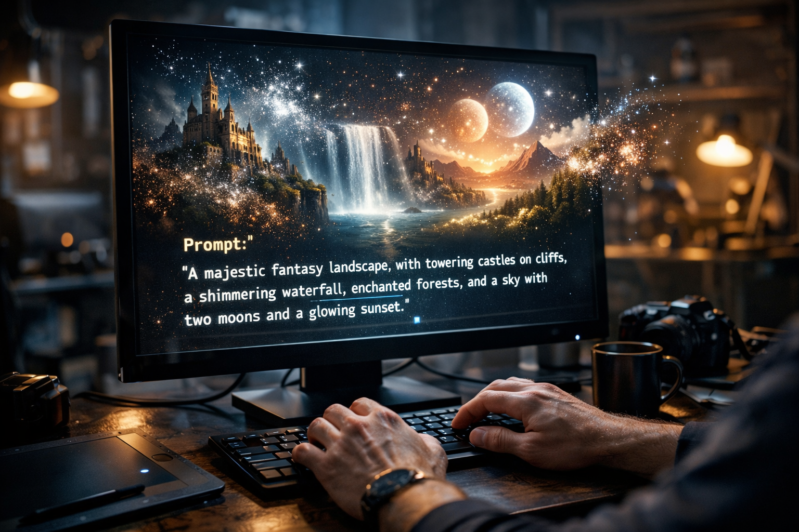
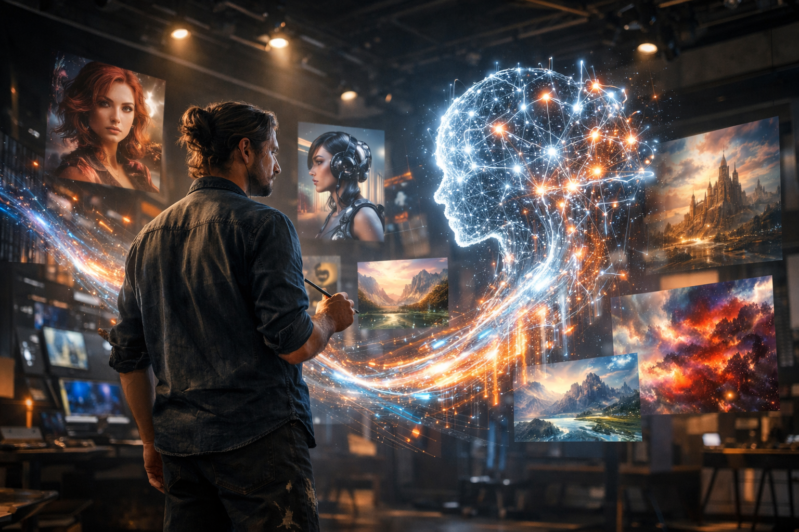
Digital artist creating an enchanting fantasy landscape featuring castles, waterfalls, and twin moons on a computer screen.
Step 1: AI Learns From Millions of Images
Before an AI can generate art, it must first learn what the world looks like.
Developers train AI models using massive datasets containing millions (or billions) of imagespaired with text descriptions.
For example:
photo of a cat
sunset over mountains
portrait of a smiling woman
polar bear in the Arctic
During training, the AI learns:
what objects look like
how light behaves
how textures appear
how different styles work
Over time, the model begins to understand patterns between words and visual features. It doesn’t memorize images. Instead, it learns statistical relationships between shapes, colors, and concepts.
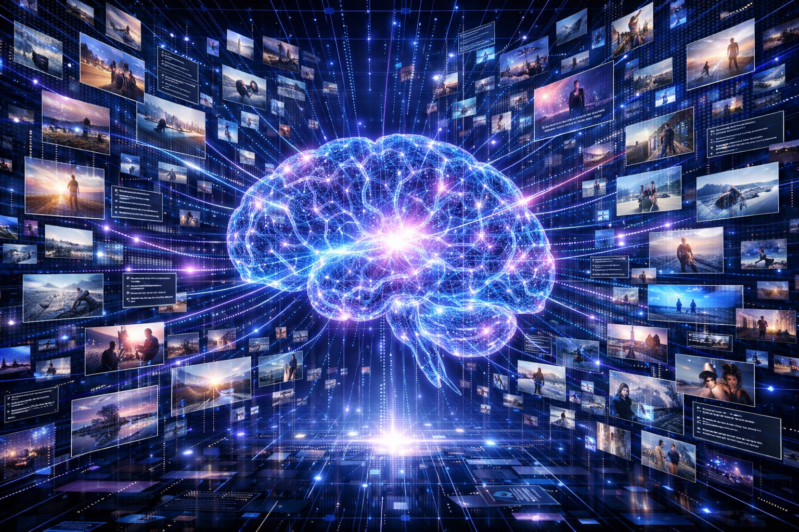
A vibrant digital brain in a virtual network of multimedia information and data streams.
Step 2: Images Start as Pure Noise
Here’s the surprising part.
AI doesn’t begin by drawing objects.
It starts with random visual noise — something that looks like TV static.
Literally just chaos.
Then the model slowly transforms that noise into a coherent image. This process is called diffusion.
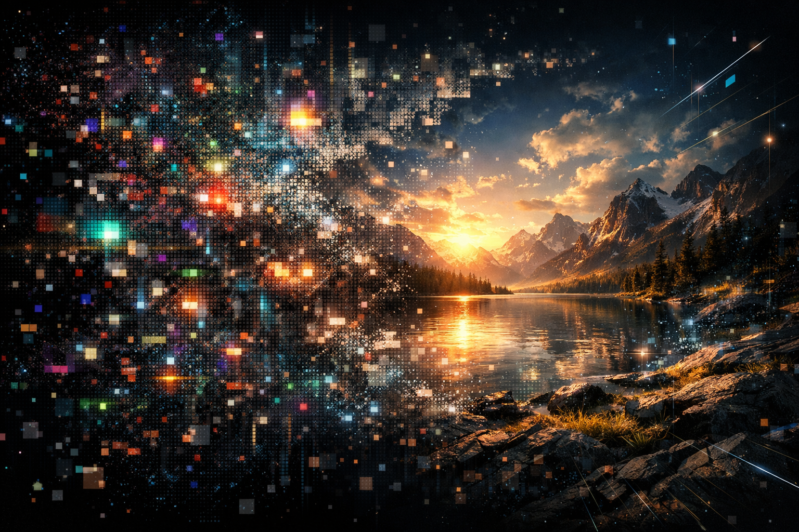
Sunset over a tranquil mountain lake blending natural beauty with a dynamic digital pixelation effect on one side.
Step 3: The Diffusion Process
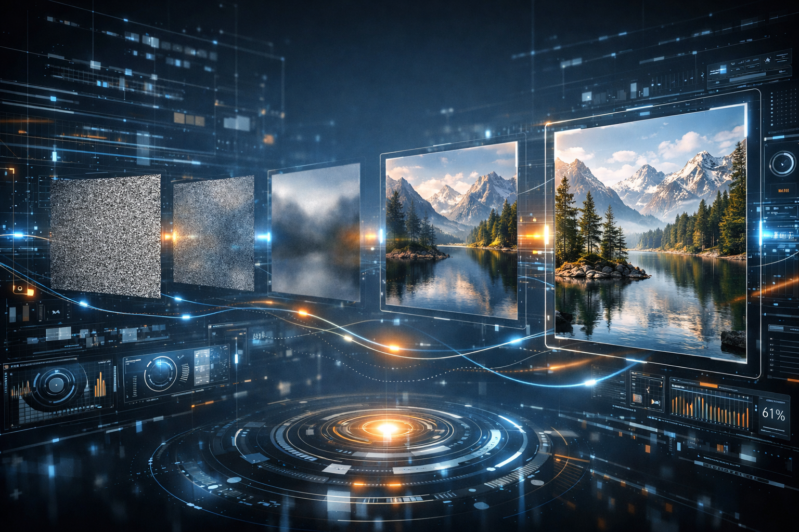
Diffusion models work by gradually removing noise from an image.
Imagine a sculptor carving a statue from a block of marble. Each step reveals more detail. AI does something similar:
1️⃣ Start with random noise 2️⃣ Predict what the image should look like 3️⃣ Remove some noise 4️⃣ Refine shapes and textures 5️⃣ Repeat dozens of times
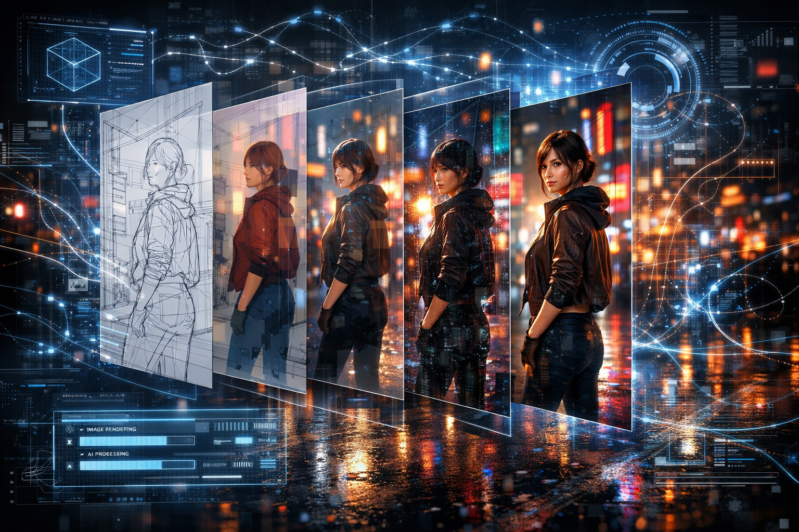
After many iterations, the noise transforms into a detailed image matching the prompt. It’s like watching a photograph emerge from fog.
An AI-powered transformation illustrating the progressive enhancement from unclear to vivid landscape imagery.
Step 4: Understanding the Prompt
To interpret your prompt, AI uses another powerful system called a transformer model.
This technology understands language and converts text into mathematical representations.
For example, the prompt: “golden sunset over mountains” is converted into numerical vectors representing:
colors
lighting
objects
style
composition
The AI then uses these signals to guide the diffusion process. This is why even small prompt changes can dramatically affect the final image.
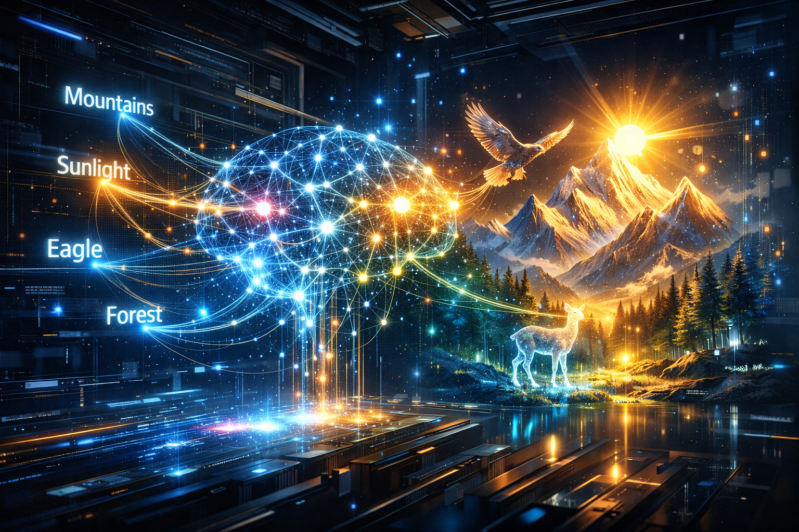
An AI brain visualizes connections to nature elements like mountains, sunlight, eagle, and forest in a glowing digital landscape.
Step 5: Building the Final Image
During generation, the AI repeatedly asks itself:
“Does this image match the prompt?”
If not, it adjusts.
Over dozens of refinement steps, the image becomes:
sharper
more detailed
closer to the description
Eventually, the AI produces a fully formed imagethat never existed before.
A woman’s transformation from a digital sketch to a photorealistic figure in a vibrant, tech-inspired city scene.
Why AI Images Look So Real
Modern AI models are incredibly powerful because they learn from huge visual datasets.
This allows them to recreate:
realistic lighting
natural textures
depth of field
photographic composition
cinematic color grading
That’s why many AI images now look like professional photography.
Some are nearly impossible to distinguish from real photos.
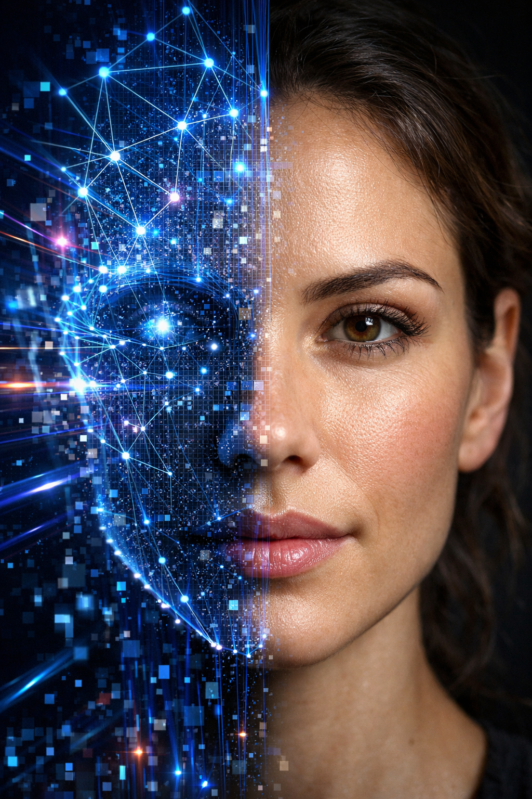
Digital artwork blending a human face with an AI-inspired glowing network to symbolize human-AI integration.
The Most Popular AI Image Generators
Several powerful AI models dominate the world of AI art today:
Each uses slightly different architectures, but most rely on diffusion models combined with transformer language systems.
Why AI Art Is Exploding in Popularity
AI image generation has completely changed the creative landscape.
What once required:
expensive cameras
professional studios
years of training
can now be created with a single prompt.
This opens incredible possibilities for:
photographers
designers
marketers
game developers
filmmakers
content creators
AI has essentially become a new creative tool, not a replacement for human imagination.
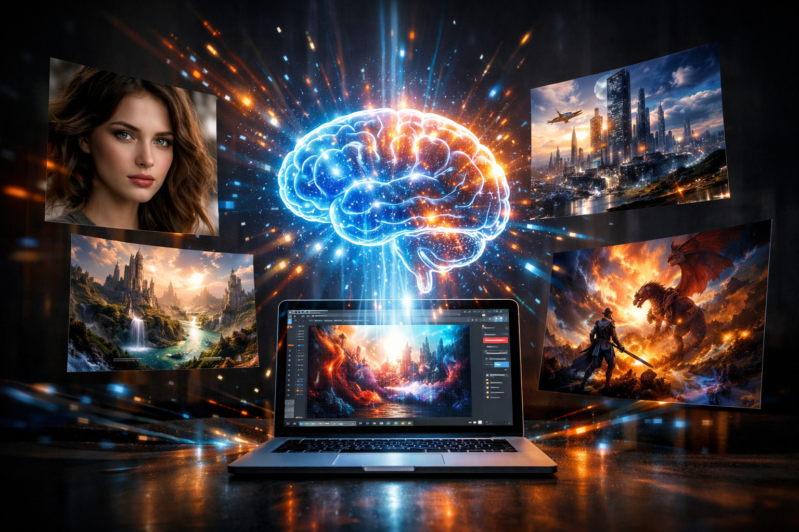
A vibrant AI-generated brain concept floating above a laptop displaying various digital artworks in fantasy and sci-fi themes.
Is AI Art the Future of Creativity?
AI will never replace human creativity.
But it amplifies it.
The most powerful AI images are not random — they come from people who know how to:
write great prompts
understand composition
guide the AI creatively
In other words:
AI is the brush.
Humans are still the artist.
Digital artist explores AI-generated visuals linked to futuristic art and technology in a creative workspace.
Final Thoughts
The next time you see a stunning AI image online, remember:
It wasn’t drawn by hand.
It wasn’t taken by a camera.
It began as pure mathematical noise — transformed step by step into art by artificial intelligence.
And we are only at the beginning.
AI image generation is evolving rapidly, and the future of digital creativity will likely be shaped by a powerful collaboration between human imagination and machine intelligence.